
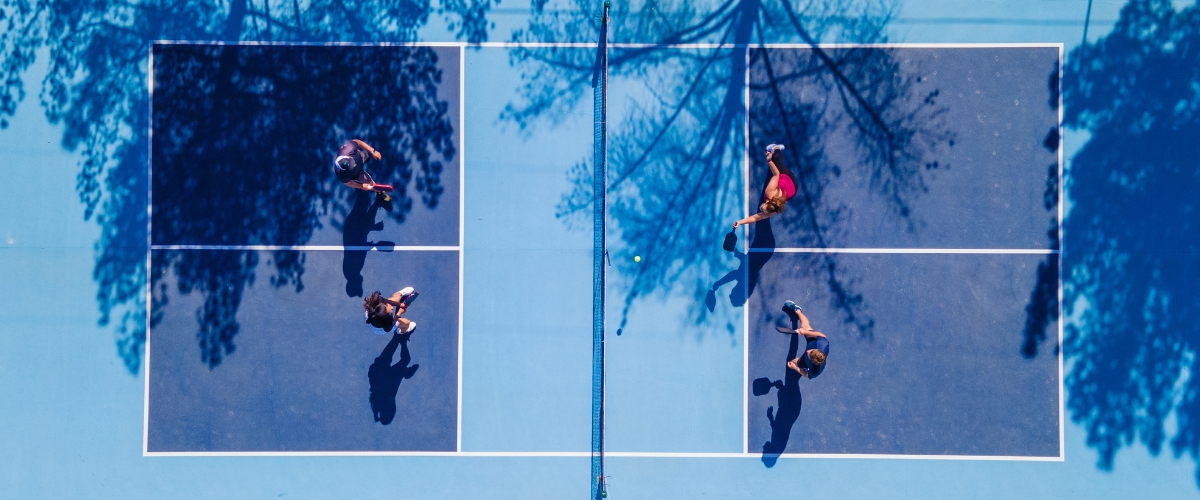
You are locked in a high-stakes dink battle at the pickleball kitchen. The ball moves back and forth with rhythmic precision. Suddenly, your opponent leans into a crosscourt shot that pulls you toward the sideline. Instead of staying back, you leap through the air, hovering outside the pickleball court dimensions, and smash the ball before it even crosses the net. This spectacular move is the pickleball erne. It is named after Erne Perry, the legendary player who first popularized this aerial assault in competitive play. Today, it stands as one of the most feared weapons in a pro’s arsenal. It turns a defensive dink into an offensive highlight. You need more than just guts to pull it off. You need a deep understanding of pickleball rules and spatial awareness.
What Is a Pickleball Erne?
Pickleball erne is an advanced offensive volley. It happens when a player hits the ball while standing outside the sideline or jumping over the non-volley zone corner. The goal is to intercept the ball closer to the net than usually allowed. It’s a legal way to bypass kitchen restrictions.
This move requires precise footwork. You aren’t allowed to touch the non-volley zone lines during a volley. By moving completely outside the court boundaries, you can strike the ball with downward force. It’s an aggressive tactic that catches opponents off guard. And it’s incredibly effective in 2026 pro play.
Why Is the Pickleball Erne Important?
It breaks the dink deadlock. Standard pickleball matches often turn into long, defensive dink rallies at the net. The Erne forces your opponent to change their strategy. But it does more than just win a single point. It creates massive psychological pressure.
When you threaten an Erne, your opponent gets nervous. They start hitting dinks toward the middle to avoid the sidelines. This predictability gives you and your partner more control over the pickleball court. You’re basically shrinking their safe target area. It’s a mental game-changer. They won’t feel safe anywhere.
How to Do a Pickleball Erne?
The process starts with a disguise. You must wait for your opponent to look down at their own paddle. As they prepare a wide crosscourt dink, you strike. Run or jump toward the sideline and clear the non-volley zone corner perfectly. You must land outside the court lines.
Keep your eyes on the ball. Catch it at its highest point before it crosses the net plane or just as it reaches you. Use a quick wrist snap to put the ball away. But don’t touch the net. And make sure your feet aren’t touching the kitchen line. It’s a fast, athletic feat. Practice it slowly first.
When Should You Use a Pickleball Erne?
Timing is everything here. Use it when your opponent is pulled wide and looks off-balance. If they’re consistently hitting dinks to your sideline, the trap is set. But don’t do it every time. Deception is your best friend in pickleball tournaments. If they’re waiting for it, they’ll lob you.
Check your court position. Only attempt this if you’re already near the non-volley zone line. If you’re too far back, you won’t make the jump in time. Make sure your partner knows your plan. They need to cover the middle while you’re out of bounds. Communication is vital. Go for it when the reward outweighs the risk.
What are the prerequisites for learning the Erne?
You cannot run before you can walk. The pickleball erne requires a solid foundation of fundamental skills. It’s not a shot you try on day one of pickleball classes near me. First, you must possess a consistent dink. You need the ability to keep the ball low and unattackable while waiting for the perfect opening. This patience is what sets up the opportunity. Without it, you are just rushing into a mistake. You also need explosive lateral movement. Speed is the engine that drives this play. If you cannot move from the center of the non-volley zone to the sideline in a split second, the ball will pass you by. Finally, you must have an instinctive grasp of the pickleball kitchen boundaries. You need to know exactly where your feet are at all times. One inch of rubber touching that line during a volley ends the point instantly. It’s a game of inches. Master your footwork first.
Is the Erne legal in pickleball according to official rules?
Yes, the shot is completely legal. Many new players think it’s a trick or a violation. It isn’t. The pickleball rules doubles and singles play both allow you to hit the ball from outside the court sidelines. The key is where your feet are when you make contact. As long as you don’t touch the non-volley zone or its lines while volleying the ball, the shot counts. You can even stand on the out-of-bounds area next to the net to hit it. This is why the pickleball erne is so effective. It bypasses the traditional pickleball kitchen rules by moving the player to a space where those rules no longer apply. You are essentially finding a loophole in the geometry of the pickleball court. Just remember that the ball must still cross over or around the net. You cannot reach over the net to hit a ball that hasn’t crossed the plane yet. Keep your paddle on your side. Then, strike with confidence.
Understanding pickleball kitchen rules for the Erne
Can you land in the kitchen after an Erne? No. This is the most common mistake players make during pickleball tournaments. If you volley a ball, your momentum cannot carry you into the non-volley zone. This includes the lines and the area inside them. If you jump from behind the line and land inside the pickleball kitchen after hitting the ball, you lose the point. You must re-establish both feet on the playing surface outside the non-volley zone before you can touch it again. This is why most players aim to land completely outside the court sidelines. It is the safest way to avoid non-volley zone violations. Think of the kitchen as lava. Once you start the Erne motion, that blue paint is off-limits until the ball is dead or you’ve reset your position. Stay outside the lines. Protect your point.
How to hit a pickleball erne in 5 steps?
Executing this shot requires a blend of deception and athleticism. It’s a calculated risk. Follow these steps to master the mechanics.
1. Setting up the Erne with a crosscourt dink
The setup is everything. You need to bait your opponent into hitting the ball where you want it. Hit a deep, shallow dink toward the opponent directly across from you. Aim for their outside foot. This forces them to reach and usually results in a predictable return toward your sideline. When they look down at the ball, they lose sight of your movement. That is your window. Use their lack of vision to your advantage. Move toward the sideline as they prepare their stroke. You are setting the trap. Wait for the bait to be taken.
2. Recognizing the right timing for the shot
Timing is the difference between a winner and an unforced error. Use these erne shot timing tips to stay ahead. Watch your opponent’s paddle angle closely. If their paddle face is open and they are leaning forward, they are likely going for a soft dink. Look at their shoulders. If they are squared up to the sideline, the ball is coming your way. You must move the moment they commit to the swing. If you go too early, they will see you and hit the ball behind you. If you go too late, the ball will be past you. Move with purpose. Trust your eyes.
3. Choosing between a jump Erne and a step Erne
You have two main options for positioning. The step Erne is more stable. You simply walk around the pickleball kitchen corner and stand on the out-of-bounds concrete. This is great for beginners or those with less vertical leap. The jump Erne is more aggressive. You leap from the non-volley zone sideline, over the corner of the kitchen, and land out of bounds. This allows you to intercept the ball much higher and faster. It’s the preferred method in high-level pickleball brackets. Choose the one that fits your athleticism. Both are deadly when used correctly.
4. How to jump around the kitchen for an Erne
The delete is a technical feat. You aren’t just jumping forward. You are jumping diagonally. Start with your weight on your outside foot. Push off hard as the opponent strikes the ball. Aim to clear the corner of the pickleball kitchen entirely. Your body should be in the air as you pass the net post. This ensures you aren’t touching any part of the pickleball court lines. Keep your eyes on the ball throughout the flight. Land softly on your feet outside the sideline. Balance is key. Stay upright.
5. Executing the aerial contact
Now comes the finish. You are in the air or standing out of bounds. The ball is floating toward the sideline. Use your pickleball paddles to snap the ball downward. Don’t just tap it. You want to end the point immediately. Aim for the open court or the opponent’s feet. Because you are so close to the net, you have a massive angle to work with. It’s a high-percentage put-away if you make clean contact. Keep your wrist firm. Follow through toward the target. Celebrate the point.
What is the difference between a pickleball Erne vs ATP?
The Erne and the around the post (ATP) are often confused. They both involve the sidelines, but they are very different. An around the post shot happens when an opponent hits a ball so wide that it bounces outside the court. You chase it down and hit it back into the court by going around the net post rather than over the net. It’s a reactive shot. In contrast, the pickleball erne is a proactive shot. You are jumping forward to intercept a ball before it even bounces. While the ATP is usually a low, defensive recovery, the Erne is a high, offensive attack. One is about survival. The other is about dominance. Both require knowing your pickleball dimensions. Master both to become a sideline threat.
What are the best pickleball Erne drills for practice?
You need repetition to build muscle memory. Start with shadow Ernes without a ball. Simply practice the footwork of stepping or jumping around the kitchen corner until it feels natural. Next, grab a partner for pickleball drills. Have them feed you soft dinks toward the sideline while you practice the timing of your move. For the most consistent results, use an Erne Pickleball Machine. This tool can feed you the exact same shot hundreds of times. It allows you to fine-tune your jump height and contact point without tiring out a partner. You can find these machines at many pickleball indoor courts or specialized clubs. Work on your landing. Perfect your snap. Do it again.
How to defend against a pickleball Erne shot?
Don’t be a victim. If you see an opponent shifting toward the sideline, they are looking for the pickleball erne. The best defense is smart dinking. Keep your dinks toward the middle of the pickleball kitchen. This takes away the angle they need to jump around the net. If you must dink wide, keep it extremely low and fast. This makes it harder for them to time their jump. You can also use a fake dink. Act like you are going wide, then pull the ball back into the center at the last second. This leaves them jumping into empty space. Watch their feet. Stay one step ahead. Control the middle.
Common mistakes to avoid when attempting an Erne
Errors will happen. Learning from them is how you improve. One major mistake is jumping too early. If the opponent sees you moving, they will just hit a 3rd shot drop or a dink to the open court you just left. Another issue is touching the net. In the heat of the moment, it’s easy to brush against the net or the post. This is an immediate fault. You must also be careful not to drag your back foot. If your toe clips the non-volley zone line as you leap, the shot is illegal. Finally, don’t forget about your partner. If you miss the Erne, you’ve left a huge hole in your defense. Communicate clearly. Recover quickly.
Frequently asked questions about the Erne
- Who invented the Erne? It is named after Erne Perry, who introduced the shot to the competitive scene in the early 2010s.
- Can you hit an Erne in singles? Yes, it is legal in both singles and doubles, though it is more common in doubles due to the kitchen dynamics.
- Is the Erne legal if I land on the line? No, touching any part of the non-volley zone line while volleying is a fault.
- Do I have to jump? No, you can simply step around the post and stand out of bounds to hit the shot.
- Where can I get pickleball lessons near me to learn this? Many local clubs offer advanced clinics specifically for specialty shots like the Erne and ATP.
Ready to take your advanced pickleball shots to the next level?
Mastering the pickleball erne will change how people play against you. They will think twice before hitting a wide dink. They will feel the pressure every time they approach the net. This shot isn’t just about the points you win. It’s about the mental edge you gain. Start by practicing your footwork on a pickleball court near you. Focus on the rules and the timing before you worry about the power. If you want to see it in action, search for pickleball youtube videos of top pros like Ben Johns or Anna Leigh Waters. They use this move to perfection. Now it’s your turn. Go out there and jump. Hit the shot. Own the kitchen.
Stay Updated!
Subscribe to our newsletter and never miss the latest updates, tips, and exclusive content.